
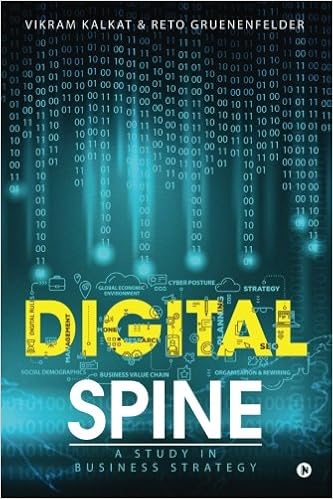
Digital Spine: : A Study in Business Strategy by Vikram Kalkat, Reto Gruenenfelder

Recently read this very interesting book Digital Spine by Vikram Kalkat and Rep Gruenenfelder. This book  talks about a business strategy for the digital era. It delves deep into the business drivers of digital revolution that’s happening all around us.  The authors have used data and facts to underscore the significance of digitization in today's time. At the same time they reflect on how future would be impacted by the same.


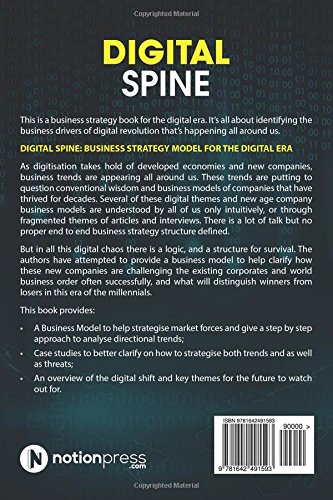
As digitization takes hold of advanced economies and innovative companies, business trends are seeming all around us. These trends are putting to question the predictable wisdom and business models of corporations that have thrived for decades. Several of these digital models and new age company business themes are only understood by all of us only naturally, or through scrappy themes of articles and interviews. There is a lot of chatter but no proper end to end structure defined. 

But in all this digital chaos there is a reason, and a structure for subsistence. The authors have endeavored to offer a business model to help explain how these new companies are stimulating the existing corporates and world business order often fruitfully, and what will differentiate winners from losers in this era of the millennials. 
This book provides: 

• A Business Model to help strategise market forces and give a step by step approach to analyse directional trends; 
• Case studies to better clarify on how to strategise both trends and as well as threats; 

• An overview of the digital shift and key themes for the future to watch out for. 


The Book is an insightful read and a good read for everyone affected or working in a digital ecosystem. It is relevant to the times and ecosystems we work in today. 

Publisher - Notion Press
Price - INR 200
Pages - 89

Comments

Also read

Does India need communal parties?

I think, it was Tan's post on this blog itself, Republic Day Event, where this question was raised. My answer. YES. we need communal parties even in Independent, Secular India. Now let me take you, back to events before 1947. When India was a colony of the British Empire. The congress party, in its attempt to gain momentum for the independence movement, heavily used Hinduism, an example of which is the famous Ganesh Utsav held in Mumbai every year. Who complains? No one. But at that time, due to various policies of the congress, Muslims started feeling alienated. Jinnah, in these times, got stubborn over the need of Pakistan and he did find a lot of supporters. Congress, up till late 1940's never got bothered by it. And why should we? Who complains? No one. But there were repercussions. The way people were butchered and slaughtered during that brief time when India got partitioned, was even worse than a civil war scenario. All in the name of religion. And there indeed was cr...

Debate : Do the ends justify the means...

Note : Give it all a fair thought before you jot down... Flaming and religion-bashing will not be tolerated. Your participation is gladly appreciated. I dunno if you folks remember this incident; a couple of yrs back, the UPSC exam had a question where the emainee had to assert his views on *revolutionary terrorism* initiated by Bhagat Singh. As is typical of the government, hue and cry was not far behind... Anyway, let us look at some facts -   Bhagat Singh was an atheist, considered to be one of the earliest Marxist in India and in line with hi thinking, he renamed the Hindustan Republican Party and called it the Hindustan Socialist Revolutionary Party. Bhagat Finally, awaiting his own execution for the murder of Saunders, Bhagat Singh at the young age of 24 studied Marxism thoroughly and wrote a profound pamphlet “Why I am an Atheist.” which is an ideological statement in itself. The circumstances of his death and execution are worth recounting. Although, Bhagat Singh had a...

The Camel Club by David Baldacci

A twisty conspiracy, a vigilante group, and a world-shaking terrorist plot—David Baldacci’s The Camel Club delivers intrigue, tension, and surprises. This review explores its highs, lows, and what makes it a must-read. Also, don’t miss recommendations for five thrilling reads to curl up with this December. What Makes The Camel Club A Gripping read? David Baldacci’s The Camel Club is a masterclass in blending suspense, action, and political intrigue. Set in the heart of Washington, D.C., the story follows Oliver Stone and his ragtag group of conspiracy theorists. They witness a chilling murder, setting off a chain reaction that reaches the corridors of power. Alongside Secret Service agent Alex Ford and intelligence chief Carter Gray, we’re drawn into a labyrinth of plots within plots. Who Are The Camel Club, and Why should You Care? The titular club is a quirky mix of outcasts, each bringing unique skills to the table. At the centre is Oliver Stone, an enigmatic man with a shadowy p...