
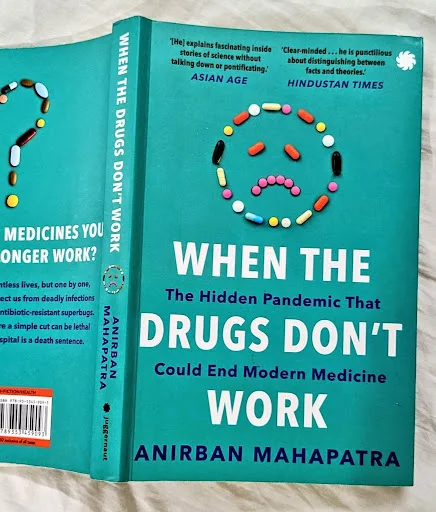
When The Drugs Don't Work by Anirban Mahapatra

 "The age of antibiotics is ending. If we don’t act now, we will soon find ourselves in a world where minor injuries and common infections are deadly once more."

📚 Just finished reading "When The Drugs Don't Work" by Anirban Mahapatra, and it was an eye-opener! Reminded me of another great book Bottle of Lies. Different context, similar recupersesion.

Have you ever wondered what would happen if antibiotics stopped working? 🤔💊

The book is a sobering exploration of the crisis of antibiotic resistance. It takes readers through the history of antibiotics, their revolutionary impact on medicine, and the alarming rise of antibiotic-resistant superbugs. 

Mahapatra's narrative sheds light on a future where common infections could once again become deadly. This is a read for anyone concerned about the future of healthcare and the steps we must take to prevent a global health catastrophe. 
ANIRBAN MAHAPATRA is the author of the book, COVID-19: Separating Fact from Fiction, and writes a popular science column for the Hindustan Times.

Non-fiction/Health
Price - Rs 599
Publisher - 
Juggernaut Books 

Comments

Also read

The Camel Club by David Baldacci

A twisty conspiracy, a vigilante group, and a world-shaking terrorist plot—David Baldacci’s The Camel Club delivers intrigue, tension, and surprises. This review explores its highs, lows, and what makes it a must-read. Also, don’t miss recommendations for five thrilling reads to curl up with this December. What Makes The Camel Club A Gripping read? David Baldacci’s The Camel Club is a masterclass in blending suspense, action, and political intrigue. Set in the heart of Washington, D.C., the story follows Oliver Stone and his ragtag group of conspiracy theorists. They witness a chilling murder, setting off a chain reaction that reaches the corridors of power. Alongside Secret Service agent Alex Ford and intelligence chief Carter Gray, we’re drawn into a labyrinth of plots within plots. Who Are The Camel Club, and Why should You Care? The titular club is a quirky mix of outcasts, each bringing unique skills to the table. At the centre is Oliver Stone, an enigmatic man with a shadowy p...

Cutting people off isn’t strength—It is a trauma response

Your ability to cut people off and self-isolate is not a skill you should be proud of—It is a trauma response Cutting people off and self-isolating may feel like a protective shield, but it is often rooted in unresolved or unhealed trauma and an inability to depend on others. While these behaviors seem like self-preservation, they end up reinforcing isolation and blocking meaningful connections. Confronting these patterns, seeking therapy, and nurturing supportive relationships can help break this unhealthy cycle. Plus, a simple act like planting a jasmine plant can symbolise the start of your journey towards emotional healing. Why do we cut people off and isolate? If you’re someone who prides themselves on “cutting people off” or keeping a tight circle, you might believe it’s a skill—a way to protect yourself from betrayal, hurt, or unnecessary drama. I get it. I’ve been there, too. But here’s the thing: this ability to isolate yourself is not as empowering as it may seem. In fact, i...

Does India need communal parties?

I think, it was Tan's post on this blog itself, Republic Day Event, where this question was raised. My answer. YES. we need communal parties even in Independent, Secular India. Now let me take you, back to events before 1947. When India was a colony of the British Empire. The congress party, in its attempt to gain momentum for the independence movement, heavily used Hinduism, an example of which is the famous Ganesh Utsav held in Mumbai every year. Who complains? No one. But at that time, due to various policies of the congress, Muslims started feeling alienated. Jinnah, in these times, got stubborn over the need of Pakistan and he did find a lot of supporters. Congress, up till late 1940's never got bothered by it. And why should we? Who complains? No one. But there were repercussions. The way people were butchered and slaughtered during that brief time when India got partitioned, was even worse than a civil war scenario. All in the name of religion. And there indeed was cr...