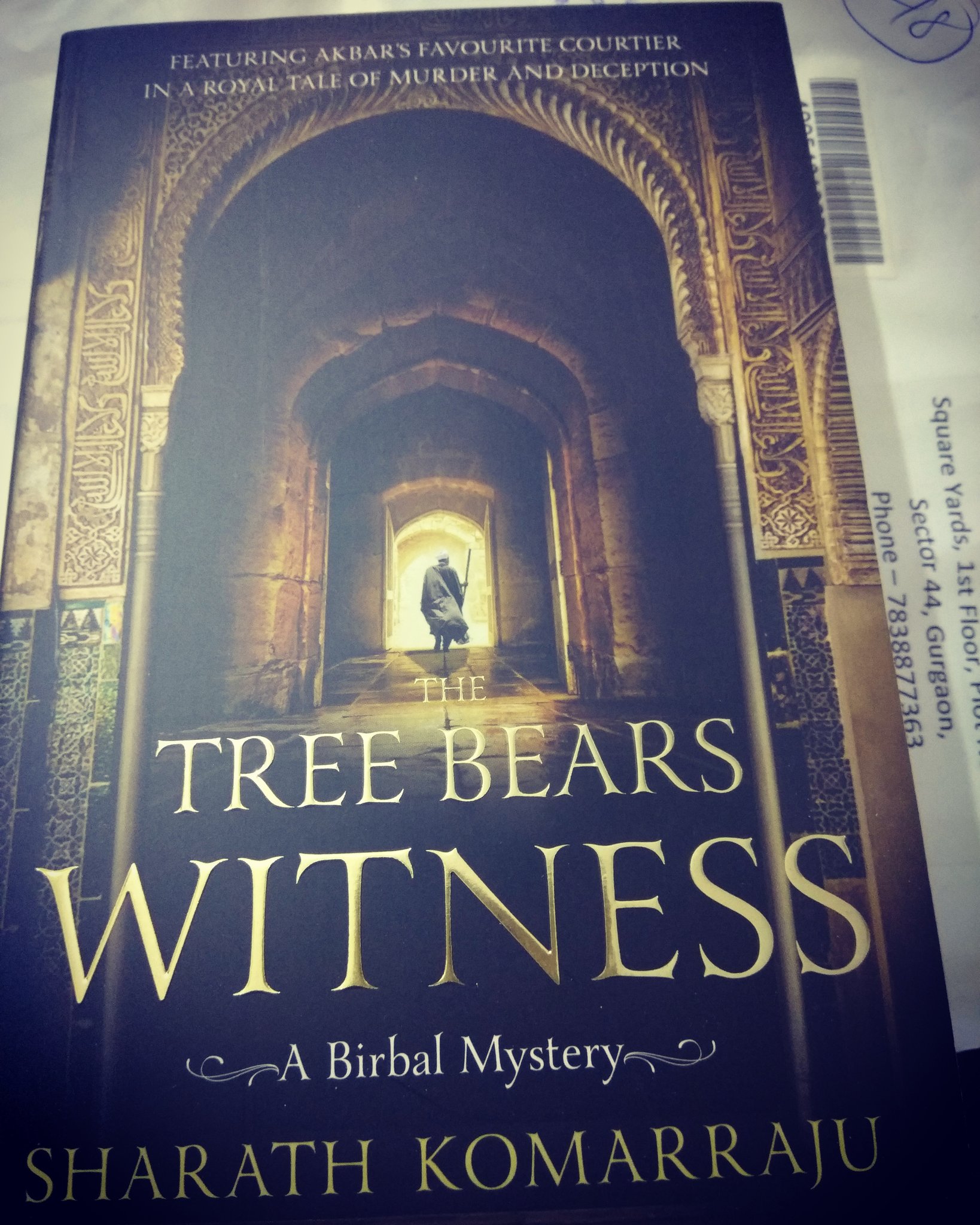
The Tree Bears Witness - Sharath Komarraju - Book Review


Sharath Komarraju's book Tree Bears Witness was released last month and I just copy last evening. Liked it so much, I finished it in a single sitting. So what's the book all about?

Emperor Akbar has just married the Rajput princess Hira Kunwari and one of the wedding guests ends up dead. The man, Sujjamal is also the princess's favorite brother but disliked by most of the party. That he is found dead in mysterious circumstances in his own palace could have serious implications on the political and personal life of the King. 

Himself a suspect, the King turns to his favorite and reliable courtier, Birbal to solve this mystery. Even for the witty Birbal, this is a challenge. For, the garden in which murder happened, the two guards on duty have different versions to tell. The murderer simply vanished into thin air. 

Everyone from the King to the cousins of the dead man, to King's half-brother. Motives aplenty but how the murder was done, remains elusive till the very end of this intriguing mystery book.

The author has very well used the Mughal Era as a backdrop. The recurrence of popular characters like Akbar and Birbal lend an ingenuity to the story.
Pages - 241

Price - INR 350

Publisher - Westland

Comments

Also read

Spill the Tea: Ira and the quiet exhaustion of being watched

Ira comes for tea and slowly reveals a life shaped by emotional surveillance. Loved, watched, and quietly evaluated by her parents, she lives under constant explanation. Through food and confession, she names the exhaustion of being known too well and finds nourishment not just in eating, but in finally being heard. Ira arrived  five minutes early and apologized for it. The way people do when they are used to taking responsibility for time itself. She said it lightly, as if time itself had offended her. She wore a white A-line shirtdress, clean and careful, the kind that looks chosen for comfort but ends up signaling restraint. When she sat down, she folded herself into the chair unconsciously. One leg rested on the floor, the other tucked underneath her, knees visible. It was not a pose meant to be seen. It slipped out before her body remembered how to protect itself. I noticed the brief softness of it, the quiet vulnerability, before she settled and forgot. I was still pouring t...

Cutting people off isn’t strength—It is a trauma response

Your ability to cut people off and self-isolate is not a skill you should be proud of—It is a trauma response Cutting people off and self-isolating may feel like a protective shield, but it is often rooted in unresolved or unhealed trauma and an inability to depend on others. While these behaviors seem like self-preservation, they end up reinforcing isolation and blocking meaningful connections. Confronting these patterns, seeking therapy, and nurturing supportive relationships can help break this unhealthy cycle. Plus, a simple act like planting a jasmine plant can symbolise the start of your journey towards emotional healing. Why do we cut people off and isolate? If you’re someone who prides themselves on “cutting people off” or keeping a tight circle, you might believe it’s a skill—a way to protect yourself from betrayal, hurt, or unnecessary drama. I get it. I’ve been there, too. But here’s the thing: this ability to isolate yourself is not as empowering as it may seem. In fact, i...

Does India need communal parties?

I think, it was Tan's post on this blog itself, Republic Day Event, where this question was raised. My answer. YES. we need communal parties even in Independent, Secular India. Now let me take you, back to events before 1947. When India was a colony of the British Empire. The congress party, in its attempt to gain momentum for the independence movement, heavily used Hinduism, an example of which is the famous Ganesh Utsav held in Mumbai every year. Who complains? No one. But at that time, due to various policies of the congress, Muslims started feeling alienated. Jinnah, in these times, got stubborn over the need of Pakistan and he did find a lot of supporters. Congress, up till late 1940's never got bothered by it. And why should we? Who complains? No one. But there were repercussions. The way people were butchered and slaughtered during that brief time when India got partitioned, was even worse than a civil war scenario. All in the name of religion. And there indeed was cr...